

Recommendation
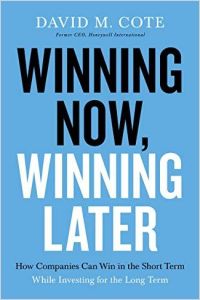
Driven by market demands for continually improving short-term profits, many businesses sacrifice long-term growth in favor of bolstering their quarterly numbers. But it doesn’t have to be that way, argues David Cote, former CEO of the Honeywell multinational conglomerate. Drawing on his experience of turning Honeywell from a failing $20 billion business into a thriving $120 billion enterprise, he challenges leaders to embed strategic thinking into their everyday decision-making and create a culture that will allow their organization to grow successfully, continuously and sustainably while still delivering short-term results.
Take-Aways
- Apply intellectual rigor to business decisions to achieve short- and long-term results.
- Honest accounting, a long-term focus and “perpetual restructuring” are pivotal to successful strategic planning.
- Resolving legacy issues now will bring future benefits – even if the immediate cost seems high.
- To create a flexible, cost-efficient, profitable business, get everyone into the habit of continuous process improvement.
- If you want a high-performance culture, promote it habitually.
- Creating a strong leadership team requires uncompromising recruitment, appropriate compensation and effective succession planning.
- To build your business, pay detailed attention to customers’ needs and experiences.
- Some 80% of mergers and acquisitions (M&A) fail to deliver a return on investment. To avoid that fate, use a disciplined M&A process.
- When making decisions in tough times, never forget your long-term goals.
Summary
Apply intellectual rigor to business decisions to achieve short- and long-term results.
Many business leaders believe that hitting short-term goals and investing in the long term are mutually exclusive. They wonder, for example, if they can achieve their projected quarterly numbers – a short-term objective – while also paying attention to long-run performance. Considering the immediate and future implications of a business decision requires intellectual rigor; it necessitates broadening your decision-making frame of reference beyond the factors immediately in front of you.
“Ask challenging questions of yourself and others, and push hard until you’ve uncovered satisfying answers, even if it means acknowledging difficult truths.”
If those at the top act as role models for this intellectual mindset and expect others to meet that standard, it will permeate throughout the organization. Former Honeywell CEO David Cote believes leading is fundamentally an “intellectual activity.” He urges leaders to become “scholars” of their organization, and to invest time researching and understanding their businesses.
Spend time with people at every level, in particular those at the front line. Ask probing questions – and expect well-argued and considered answers. Request numbers to back up proposals. Keep tabs on execution in the wake of a decision, and audit your metrics regularly.
Honest accounting, a long-term focus and “perpetual restructuring” are pivotal to successful strategic planning.
Before Cote became Honeywell’s CEO, its finance team regularly asked business leaders to boost their quarterly numbers artificially by capitalizing expenditures, offering end-of-quarter sales deals or asking vendors to pay fees upfront, even those who were operating under long-term contracts. While those measures made the quarterly results look good, they led to more pressure to meet increasingly unrealistic targets down the line. They reinforced a culture of “short-termism.”
“The craving for fiscal shortcuts is rather like alcoholism: When you stop, you need to do it cold turkey and permanently.”
Strategic plans should be achievable and derived from realistic data. They should account for the coming year’s operational demands. Review your financial and operational figures regularly in light of your strategic plans, and make short-term decisions in relation to your strategic objectives. This enables you to make course corrections in processes, staffing and products, rather than having to resort to radical measures, such as large-scale redundancies or selling off business units.
Such perpetual restructuring enables your organization to reinvest part of its profits into the business to improve it incrementally. For a plan based on steady growth to work, fixed costs must stay constant. Don’t increase your headcount. Focus on process improvement.
Resolving legacy issues now will bring future benefits – even if the immediate cost seems high.
Ignoring legacy issues turns them into time bombs that can cost even more to fix later than you would need to spend to tackle them now. Such problems tend to impede growth, damage reputations and undermine investor confidence.
When Cote joined Honeywell, he faced “legacy liabilities” around health, safety and environmental issues. Potential costs ran into the billions. He also had to contend with the company’s existing reputation for being uncooperative and callous.
“You can put your business on surer footing, too. Suck it up and deal with the skeletons in your closet – not next year, or in three years, but now. And for heaven’s sake, don’t do it halfway.”
Cote set funds aside to address these issues, taking a hit on short-term profits. He hired a new team of people to find innovative ways to solve these problems collaboratively, including holding conversations with people in the affected communities. While Honeywell investors initially were unhappy about the cut in profits, Cote’s consistent message to them – that making this investment positioned the company for growth – helped restore trust and build Honeywell’s reputation.
To create a flexible, cost-efficient, profitable business, get everyone into the habit of continuous process improvement.
Even small changes to your business processes can yield surprising cost and time savings. For example, when Cote was at General Electric, trainees observing the process for changing product designs found that simplifying multiple photocopying steps could reduce the seven-month cycle to four months. Involve everyone in the firm in continuous process improvement. Team members working on specific tasks and processes are likely to know best where inefficiencies occur, and might already have ideas about how to fix them. Involving team members gives them a sense of ownership and an understanding of how their role contributes to the success of the whole firm.
“Businesses of all kinds are little more than collections of processes, and in most businesses, all processes are highly inefficient. As a leader you should assume you can render any process in your organization more efficient and effective.”
Formalizing this process of continuous improvement and promoting it from the top of the organization will, over time, create a culture that’s agile, performance-oriented and efficient. Managers and staff will become accustomed to challenging their processes, to finding more efficient methods and to carrying out the necessary change.
If you want a high-performance culture, promote it habitually.
A high-performance culture is the bedrock of any successful company. Culture goes beyond staff just reciting the organization’s values and desired behavior. To embed culture in your organization, ingrain it in people’s mindset so that it directs every decision they make.
“Promote culture as if your company’s future depended on it. Because it does.”
Define the culture you want to see. Describe in detail how it would look if people demonstrated certain behaviors and lived the values that drive those behaviors. Make sure the culture feeds into training programs and performance reviews. Cote dedicated 25% of his work time to promoting culture. He met with leaders and staff to talk about culture, made sure recruitment took culture into account, and demonstrated the culture’s values in his behavior and decision-making. He considered whether company-wide processes, practices and policies reflected the culture he wanted to see. If they did not, he asked the appropriate people to change them.
Creating a strong leadership team requires uncompromising recruitment, appropriate compensation and effective succession planning.
Both good and bad leaders have a powerful influence since they set the tone for the behavior, values and performance of those who work alongside them or report to them. Talent management plays a key part in building a strong leadership team. Meaningful performance reviews help identify potential future leaders, creating a pipeline of talent you can efficiently promote into leadership positions. This ensures stability and allows operations to continue without the dip in performance that most companies expect when someone new takes a leading role.
Because Cote insisted on succession planning and talent management, he was able to replace the chief financial officer and the president of one of Honeywell’s biggest divisions internally within two days after the previous officeholders handed in their notices.He started planning his own retirement 10 years before he stepped down. He and his leadership team identified potential candidates in-house, observed how they coped with increasing responsibility and put them through a tough, formal selection process.
“To get the best people, you must pay them extremely well for what they do and give them jobs and a workplace environment that they love.”
While filling positions quickly fuels continued growth, getting the right people is even more important. When recruiting for a new role, wait for the person who fits the requirements and culture.Don’t leave senior-level hiring decisions to the HR department, particularly if you’re trying to achieve change. Pay everyone fairly, based on his or her performance, and include incentives for focusing on long-term, as well as short-term, goals. For example, the value of the stock options leaders at Honeywell received as compensation depended on the company’s long-term success.
To build your business, pay detailed attention to customers’ needs and experiences.
The products you develop and sell and the service you offer must meet your customers’ requirements. Getting product development and marketing to work together right from the start helps R&D create products that work for your customers.Have metrics in place that correctly measure customer satisfaction. Implement an audit process that verifies whether the numbers look good because they are good or only because people found ways to manipulate them. At Honeywell, metrics from all plants initially suggested that 99% of deliveries to customers were on time. However, Cote found that some reports were wrong because plant managers had overlooked errors in salespeople’s numbers, thus skewing the metrics.
“In our drive to make the numbers, we had forgotten a basic reality of business: We only continue to exist if we do such a great job for customers that they place more orders.”
Set aside funds for short- and long-term product development. If money is tight, focus on R&D process improvement and potential cost savings, perhaps through outsourcing R&D to developing countries. Identify where your strengths and weaknesses lie, and focus on areas that promise high growth. If you’re planning to grow internationally, get to know each local target market so you understand its customers’ needs.
Some 80% of mergers and acquisitions fail to deliver a return on investment. To avoid that fate, use a disciplined M&A process.
Mergers and acquisitions (M&A) increase the size of your company, but are fraught with challenges and often fail to deliver results. To give an M&A deal a better chance of success, implement four steps:
- Proactively search for businesses that have a “great position in a good industry” – Start conversations with the leaders of those companies. This will help you build an M&A pipeline of companies that align with your strategic goals.
- Perform due diligence and heed any warning signs – Set clear criteria for what you expect a deal to deliver. If it looks like it can’t measure up, step away. At this stage, it’s particularly useful to ask questions that counter confirmation bias.
- Do your own valuation instead of relying on investment bankers – This will allow you to determine a realistic price so you can make sure the deal brings value to investors. Once you’ve decided on the price you’re willing to pay, stick to it in negotiations and be prepared to walk away.
- Dedicate resources to integration – If you don’t invest in integration, you undermine the likelihood of realizing potential cost synergies.
Honeywell established full-time integration teams who contributed to due diligence early in the process, so they knew the acquired business inside and out by the time the deal completed.
When making decisions in tough times, never forget your long-term goals.
When the 2008 recession hit, Honeywell was positioned to weather the storm: Leaders and staff knew how to identify savings and process improvements; the culture prioritized value-based behaviors and decision-making; it had strong leaders in all business units, and its accounting practices encouraged short- and long-term thinking. While many businesses cut staff, investments, training and product development, Honeywell balanced short-term cost-cutting with its long-term goals so it was ready to hit the ground running when the recession ended.
“All the steps you might take to deliver strong short- and long-term performance work together to help you grow in good times and to shield you from the worst consequences in bad times.”
To achieve this, consider what is essential to your long-term growth. For example, keeping customers is a priority, so try not to make cuts that affect customer service or product quality. While cutting redundancies might bring short-term cost savings, they’ll thin your talent pool and cost you in the long term in lost experience and knowledge, as well as low morale and unenthusiastic performance. Identify roles you can cut in the long term and search for other options, such as furloughing, that let you retain staff. Decide between “bad and less-bad” options, bring your leadership team on board, and communicate openly with your staff.
About the Author
Former chairman and CEO of Honeywell David M. Cote is executive chairman of Vertiv Holdings Co., a member of the Aspen Economic Strategy Group, and a board member of the Council on Foreign Relations and the Conference of Montreal. Barron’s ranked him among the World’s Best CEOs for five years.
getAbstract maintains complete editorial responsibility for all parts of this abstract. All rights reserved. No part of this abstract may be reproduced or transmitted or used for training any machine learning system in any form or by any means – electronic, photocopying or otherwise – without prior written permission of getAbstract AG (Switzerland).