
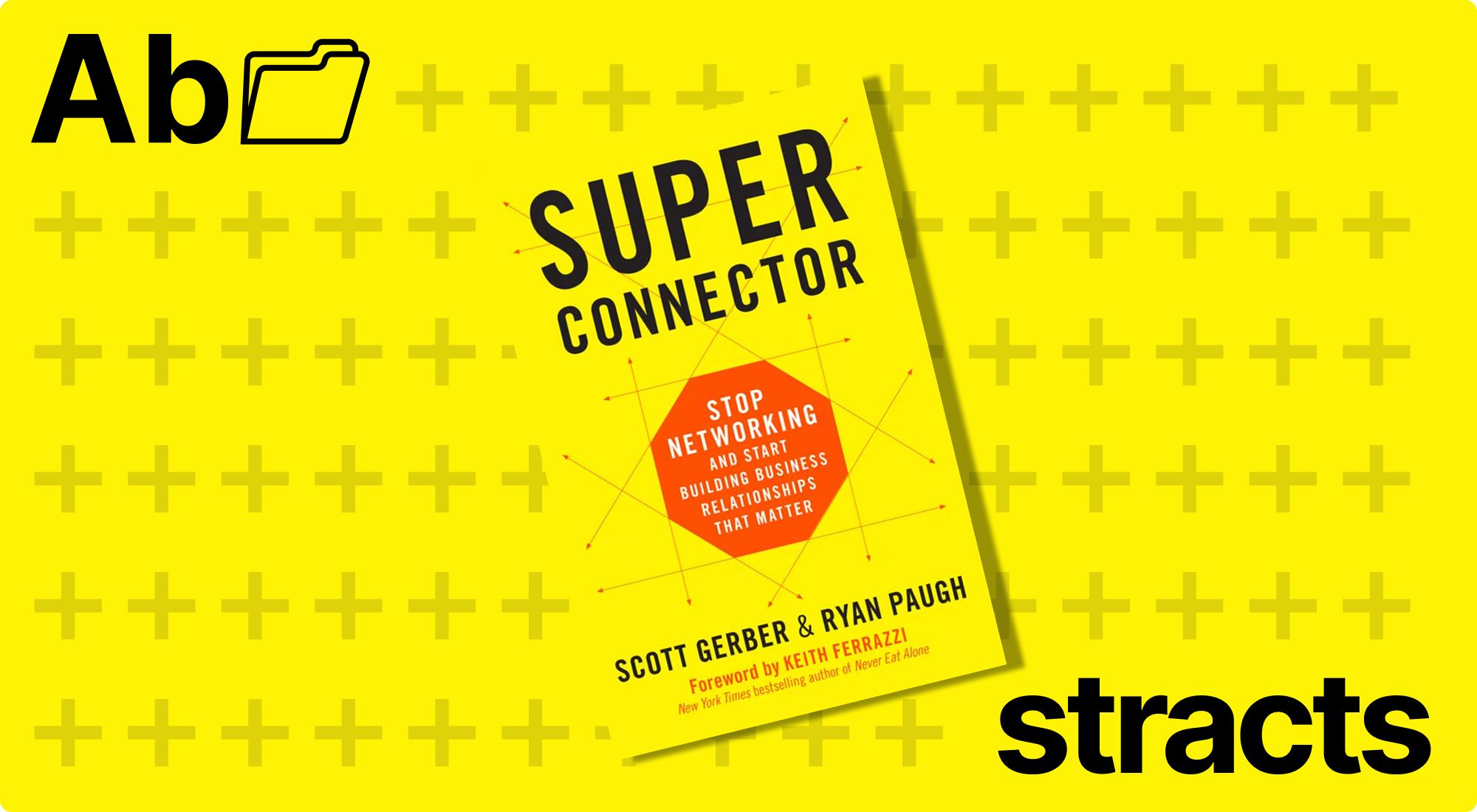
Recommendation
Thanks to the internet and social media, connecting virtually with a lot of people has never been easier. For real power, however, Scott Gerber and Ryan Paugh – who manage invitation-only professional communities – urge you to build real connections instead. The road to being an influential “superconnector” involves developing relationships that can last, one person at a time. The authors offer practical advice for creating meaningful, enduring superconnections.
Take-Aways
- In today’s busy, hyperconnected world, relationships matter.
- Conventional networking is becoming passé, but real relationships have enduring value.
- Many “superconnectors” are introverts.
- The three types of superconnectors are “thinkers, enablers” and “connection executors.”
- The best superconnector functions as a “human tollbooth.”
- For superconnectors, context is everything.
- The right introductions are essential.
- Superconnectors make the most of technology.
- Superconnectors reserve quality time for friends and family.
Summary
In today’s busy, hyperconnected world, relationships matter.
Being influential requires connecting with the people who count and building meaningful relationships that can last. These relationships are your social capital – today’s most valuable currency. To amass this capital and to use it most wisely, become a “superconnector.”
Superconnectors understand that connections represent power. Superconnectors create communities for the long-term and leverage them to achieve their goals.
“People, not money, are your most important assets; great things in business happen when the right people come together.”
Keith Ferrazzi, who coined the term “superconnector,” explains that these ace networkers are influential because they use their relationships to become “information brokers” who continually learn and connect. Because they are committed to constantly expanding their knowledge, they become increasingly attractive to know.
Conventional networking is becoming passé, but real relationships have enduring value.
Superconnecting relies on meaningful relationships that rarely develop online. Most people don’t know how to move their superficial online connections into the offline world. They may expand their email lists to include their new best friends, who might reciprocate in kind, but to what end? Many people continue this pointless circular journey, amassing as many new contacts as possible.
“Networkers like to ‘work the room’ and collect cards, but those cards don’t really mean much if the other person isn’t willing to take your calls.” (Ferrazzi Greenlight consultant Keith Ferrazzi)
Superconnectors don’t worry about reciprocity; their goal is to help. Reciprocity is almost always automatic, anyway. When you do someone a favor, the recipient is usually happy to repay it. Superconnecting establishes mutually beneficial relationships. It hinges on rendering service through meaningful discussion, acts and interactions with people whose power you can leverage. The current intersection between the corporate world and connected communities forms one arm of such connections.
Target the connections you want to develop from among influential people – the “decision makers and tastemakers” who avoid superficial networking channels like Facebook or Twitter. The people you seek tend to respond to invitation-only events. Often it takes an influential pacesetter to draw other superconnectors.
Many superconnectors are introverts.
People often assume that superconnectors are extroverts; in fact, many superconnectors are introverted by nature. But whether extroverts or introverts, all superconnectors are self-aware. They know why and how they excel, and they understand their own weaknesses and gifts. They know what works best when trying to connect with others in real ways.
The three types of superconnectors are “thinkers, enablers” and “connection executors.”
Superconnectors are highly organized without depending on expensive tools or software. Often, they create templates that enable them to connect quickly and efficiently. They excel at categorizing their contacts for practical use. One tactic you can adopt involves using a grid system to organize your contacts. If you add a “notes” column to your grid, you can list individual topics of interest or other important touchstones.
Besides being well-organized and superb time managers, superconnectors are confident, authentic and self-assured. They listen with humility and care about what other people say. As critical thinkers, they are disciplined, decisive and consistent.
Superconnectors develop high emotional intelligence. They understand their emotions, manage their feelings and can recognize how other people feel.
Collaboration expert Erica Dhawan, a co-author of Get Big Things Done: The Power of Connectional Intelligence, outlines three types of superconnectors:
- Thinkers – These curious individuals have hundreds of ideas but might not be great at executing them.
- Enablers – These superconnectors excel at bringing people together and organizing them for a common purpose.
- Connection executors – These people are masters at bringing other people’s ideas to fruition.
Superconnectors know which of these three categories suits them best and understand how to find allies with complementary skills.
Superconnectors are highly selective about the people with whom they seek to associate. This makes good sense. According to Darrah Brustein, the founder of Network Under 40, intelligent use of your time means developing primary relationships with people you know can help you achieve your objectives.
“Superconnectors know that their greatest returns come when they least expect them, and by putting others’ needs first the good karma seems to flow back to them tenfold.”
Among your connections, build a relationship with a special person – an “anchor” whose advice you trust and in whom you can confide. Your anchor should be someone who also helps you connect with others. Seek out and connect with a mentor who can offer sound advice and open doors for you to meet with influential people.
The best superconnector functions as a “human tollbooth.”
As a superconnector, you must operate at the center of your universe, meaning that you “see and hear all things…and become more worldly…and exponentially more valuable.” You become a human tollbooth, and other people must go through you to get from one point to another. Consider Jeremy Fiance, the founder and managing partner of The House Fund, a venture capital fund that concentrates on the Berkeley, California, area.
“Most people approach relationships asking what they can get. Instead, they should focus on what they can give.” (106 Miles meetup co-founder Adam Rifkin)
While a freshman at the University of California, Berkeley, Fiance wanted to start a new enterprise, but no funding sources were available. This amazed him, since Berkeley is situated right next to Silicon Valley, the world’s center of high-tech start-ups that rely on venture capital.
Fiance took matters into his own hands. He founded a Berkeley chapter of the Kairos Society, a collegiate entrepreneurship organization. While still in college, he co-founded five start-up enterprises. By the time Fiance graduated, his various start-ups had generated upward of $50 million in available venture capital. That strategy continues to let Fiance function as a human tollbooth. If you want venture funding in Berkeley, he’s the person to see.
For superconnectors, context is everything.
Superconnector relationships dive beneath the surface to acquire context, an absolute requirement for relationships that count. Superconnectors develop context through data, specificity, discussion, shared environments and mutual acquaintances.
Superconnectors use context to develop helpful profiles of the people with whom they want to connect. They learn all they can about their targets, including their interests and hobbies. Steve Sims, CEO of Bluefish, a concierge service, believes that the only way he can build relationships is by getting to know what his prospective connections like and don’t like.
“If someone has a problem that needs solving, you want to be the first person they call.”
Superconnectors ask intelligent, open-ended questions to learn about people and develop context. They don’t ask “How can I help you?” because that would undermine their credibility, especially in the opening stages of building a relationship. People often interpret “How can I help you?” as an obvious sales tactic.
“What do you do?” is another silly, counterproductive question. Instead, ask a question people that love to answer: “What are you working on?” The responses you garner will help you discover areas in which you can offer value.
As a superconnector, the purpose of your conversations is to learn about other people, not to talk about yourself. Asking “What are you working on?” is an effective way to get another person to open up about his or her important interests and activities.
The right introductions are essential.
An introduction – be it face-to-face or by email – precedes every connection. No matter what form a quality introduction takes, it should be straightforward and direct, state clear goals, offer social proof, and be brief and articulate.
“It’s not about knowing others; it’s about knowing where you thrive, how you connect [and] your favorite conversation starter.” (behavioral investigator Vanessa Van Edwards)
Every introduction should reflect “mutual value.” Both parties will have approved the introduction in advance. Except in rare circumstances, you should avoid “blind introductions” as they seldom prove productive.
Superconnectors make the most of technology.
Superconnectors leverage technology so it communicates their unique personalities instead of dehumanizing them. To optimize your use technology while connecting with other people, take advantage of several online capabilities:
- “Engage” – Cleverly attract attention. In his younger days, CMX Media CEO David Spinks would query high-profile CEOs and start online conversations with people who didn’t know that he was only 19 years old and had no power or influence. He was charming, and people were happy to communicate with him.
- “Research” – Conducting some research on social media helps you learn about other people, who they are and what matters to them. An online search or a visit to LinkedIn often reveals quality information about people you don’t yet know.
- “Convene” – The internet offers knowledge-sharing and value exchange, which is why CMX developed the CMX Hub group on Facebook, a growing organization with more than 6,000 members.
- “Enhance” – After you establish a relationship with a client, enrich it with technology. For example, use video text as an additional way to provide information.
- “Organize” – Take advantage of tools such as Mixmax, Boomerang and Contactually to help you stay organized.
Superconnectors reserve quality time for friends and family.
Don’t rush the process of becoming a superconnector. It won’t happen overnight, and there are no shortcuts. You’ll have to devote time and effort to reap the benefits. Don’t get sidetracked by superfluous distractions, such as the likes that people give your posed photos or those live-tweeting shows that you enjoy so much.
“Reputation matters. Everything you say, everything you do, everything you tweet or like or post broadcasts a piece of yourself.”
Once you start establishing meaningful connections, that activity might become all you want to do. Don’t fall into this common trap. A December 2014 study published in the scientific journal Cyberpsychology, Behavior and Social Networking reported that about 6% of the global population – about 420 million people across the planet – were internet addicts. Most experienced superconnectors agree that making quality connections requires reserving personal time for your family and friends and for the leisure activities that sustain you. Ultimately, those are your most important connections.
About the Authors
Scott Gerber is the co-founder and CEO of The Community Company, which managers invitation-only professional communities. Ryan Paugh is the co-founder and COO of The Community Company and also co-founded the Young Entrepreneur Council, an invitation-only organization for entrepreneurs age 40 and under.

getAbstract maintains complete editorial responsibility for all parts of this abstract. All rights reserved. No part of this abstract may be reproduced or transmitted or used for training any machine learning system in any form or by any means – electronic, photocopying or otherwise – without prior written permission of getAbstract AG (Switzerland).