

Recommendation
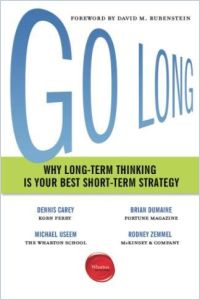
An expert panel of authors – top recruiter Dennis Carey, award-winning editor Brian Dumaine, management professor Michael Useem and McKinsey managing partner Rodney Zemmel – assert that too many CEOs prioritize short-term profits over long-term gains. In direct, economical prose, they detail and promote the merits of long-term business thinking, planning and strategizing. The authors explain how to structure and fulfill long-term strategy, and they outline the steps CEOs should prioritize to achieve far-reaching value. getAbstract recommends their commonsense, innovative manual to executives who want to escape the destructive frenzy of short-term thinking so they can lead their organizations to growth and sustained profitability.
Take-Aways
- To craft effective strategy, CEOs must become long-term thinkers.
- To embrace “go-long” thinking, CEOs need to meet the needs of all of their constituencies, not only investors.
- Short-term investors pressure CEOs to go for the quick profit: top quarterly earnings, better dividends, and so on.
- Often, CEOs respond by slashing R&D budgets, delaying new product launches and jettisoning valuable but costly senior employees.
- McKinsey estimates that long-term “buy-and-hold investors” own 75% of the American market.
- The go-long business philosophy rests on four primary principles.
- No. 1: Establish a purpose for your firm that transcends profits.
- No. 2: Develop a long-term strategy for your board and investors to approve.
- No. 3: Organize metrics to monitor long-term business success.
- No. 4: Promote a culture that values long-term business growth.
Summary
Long Term Over Short Term
The smartest, most sensible business strategy is to strive for long-term commercial success. According to research by the McKinsey Global Institute, firms with a long-term orientation that invest heavily in R&D – generally putting in 50% more than other firms – achieve about 47% more business growth than firms that invest less in R&D because they consider only short-term benefits.
“One of the toughest challenges any CEO faces is staying focused on a long-term strategy while having to deal with short-term distractions.”
On average, corporations that pursue long-term goals open 12,000 more jobs than firms that focus on the short term. McKinsey’s research notes that if all publicly listed firms in the United States had created jobs at the same impressive rate shown by firms run with long-term thinking, America’s GDP would have increased by $1 trillion since 2008.
Resisting the Quick Profit
Unfortunately, many of the institutional investors and hedge funds that corporations depend on for capital support constantly pressure CEOs to achieve maximum short-term gains. They demand that chief executives maximize quarterly earnings and dividends. They want CEOs to buy back shares. Following the lead of short-term investment organizations, many board members and senior executives also unduly pressure CEOs to go for the quick buck. However, CEOs who buckle under the heavy pressure to run their firms without fully considering the long-range picture eventually suffer negative consequences.
“Focusing on a broader target can energize employees, help shape short-term decisions and boost the bottom line.”
The stock market is another significant source of pressure driving CEOs to think only in the short term: According to the New York Stock Exchange, stockholders held on to their stocks, on average, for 5.1 years during the 1970s. Now they hold those investments for an average of 7.3 months. That change in investor behavior generates an entire category of investors who place only “short-term bets.” In a survey of more than 600 senior executives, two out of three said many of their investors constantly insist on maximizing short-term financial returns. To meet their demands, CEOs cut expenses by slashing R&D budgets, delaying new product launches and jettisoning senior – thus more knowledgeable, but more highly paid – employees.
“Many American investors are putting enormous pressure on CEOs to make a quick buck.”
“Activist hedge funds” – go-go investment firms with a tight, short-term orientation – represent only around 1% of the financial marketplace. But, these firms have a major influence on the investment sector due to their “massive war chests,” even though McKinsey estimates that long-term buy-and-hold investors own a majority – 75% – of the American market. Given that, CEOs don’t have to surrender to pressure from short-term investors. Board members and executives who resist short-termers’ demands can slow down the quick-buck bandwagon.
Go Long’s Primary Principles
Companies that follow a long-term strategy are better able to beat their competitors over time – “five, 10 or even 15 years out.” When firms go long, they can create new jobs, improve their communities, make their customers happy and enrich their shareholders. To manage according to the go-long philosophy, heed four primary principles:
1. Set a Purpose that Transcends Profits
Profits are important, but they do little to motivate employees – and unmotivated employees negatively affect profits. Your employees and suppliers want to be part of something bigger than themselves. This is particularly true for millennials, who wish to work for organizations that pursue an elevated, admirable purpose. Your financial performance reports won’t engage or inspire them. And, having your CEO tout your firm’s elevated purpose is not enough. Leaders must weave organizational purpose into their operations and ensure that the firm’s working conditions and routine practices support its stated mission.
“CEOs facing a crisis can easily become distracted by all the bush fires that they believe need extinguishing.”
For example, Unilever CEO Paul Polman organized his company around two crucial missions: to help end poverty and to establish a zero carbon footprint. He wants Unilever to sell the most “affordable and healthful” packaged goods to one billion of the world’s most disadvantaged people. To focus on the long term, Polman said Unilever would no longer report quarterly profits. Its shares lost 6% of their value in a month. However, along with – and not in spite of – its strong focus on meaningful goals, Unilever’s stock prices soon did better than its competitors. It has shown dividend growth for 37 quarters, with a shareholder return of “285% since 2008.” No other firm in its industry surpasses Unilever’s numbers.
“Going forward, CEOs must find a balance between rewarding shareholders and serving their employees, consumers and society.”
Chief executives should responsibly attend to the needs of their constituencies, including their workforce, suppliers, clients and community. This means focusing on environmental, social and governance (ESG) issues as an integral part of their culture. Companies that incorporate a noble purpose into their operations motivate employees, positively affect short-term results, more wisely shape long-term decisions and increase profits.
2. Develop a Long-Term Strategy
Often boards and funders don’t give CEOs any support for R&D, talent development and innovative marketing. Instead, they bend to investors’ demands to put funds for these programs, which would have been wiser expenditures, into stock buybacks or additional dividends. To go long, CEOs need the backing of individual board members and long-term investors who share their forward-looking attitude. Investors with a day-trader mentality never back CEOs’ long-range cost and earnings plans. Therefore, chief executives must convince other investors of the value of long-term strategic thinking.
“When going long, the goal is to create a culture that is always focused on long-term, profitable growth.”
Index funds, pension funds and university endowments should be among the biggest boosters of long-range strategizing. These institutional investors hold “some 75% of the world’s stock-market capitalization.” They believe business should do more than maximize investor returns. For such investors to commit to long-range thinking, corporate leaders must develop and communicate compelling, evidence-based arguments. Verizon CEO Ivan Seidenberg, for example, convinced his board and investors that Verizon should invest $150 billion over 10 years to create the best “wireless and broadband networks.” As result, Verizon enjoys the “highest customer satisfaction” among “business wireline” users.
3. Build Metrics to Monitor Long-Term Business Success
Chief executives need illuminating measurements to achieve long-term financial and business growth. In the absence of proper long-term metrics, day-to-day emergencies and short-term events will divert their attention and subvert long-term planning. At Verizon, Seidenberg established a “clear, easy-to-understand metric”: market-share growth. This metric proved that his long-term strategy was succeeding, as evidenced in a regular increase in sales – “quarter after quarter, year after year.” When CEO Alan Mulally took over at Ford, he employed a different long-term metric: “profitable growth for all” (PGA).
“Sometimes executing a promising long-term strategy means taking a heavy hit in short-term profits.”
Don’t rely only on long-term metrics that focus on financial growth. Include metrics that measure your organization’s progress in building strong “customer satisfaction, employee engagement and degree of growth from new products,” as well as the fulfillment of its purposeful mission.
4. Promote a Culture Devoted to Long-Term Growth
Executives, managers and employees need the support of their corporate board of directors to meet long-term plans. This demands an open corporate culture where executives and managers are honest about what works best within the company. Sweeping problems under the rug at any level won’t work. Employees and leaders must speak candidly about the issues and problems that arise as they try to meet their goals. Otherwise, problems will fester and operations will suffer.
“Any CEO who wants to take a significant near-term hit for the sake of a long-term strategy has to win the backing of the board.”
A good example of how the right corporate culture works unfolded at 3M under the leadership of CEO Sir George Buckley, who moved hundreds of millions of dollars to R&D. The result was 3M’s introduction of hundreds of innovative products – and a revitalized company. Eventually, 3M’s innovations accounted for 34% of its sales. The success of 3M’s new products hinged on its supportive, innovative corporate culture. Buckley promoted that culture with a clear message to 3M’s R&D engineers and scientists: “Take big risks.” He urged them not to worry about failure. Once these professionals knew they could attempt new ideas without fear, the commercial payoff was tremendous.
A Proper Purpose
In the 21st century, corporations must do more than serve their shareholders. They must serve the interests of their customers, communities, employees, suppliers and governments. Companies can succeed while serving both these crucial constituencies and their investors.
“ “Everyone is going to benefit if you think of what you’re doing as creating value for all.”
– Alan Mulally, former CEO, Ford Motor Company
As a leader, you want all your constituencies to experience the positive benefits of being associated with your enterprise. This requires senior executives to focus on the long-range view, and to be mature and far-seeing. That means funding R&D, investing in workplace training and development, and engaging in “environmentally and socially acceptable” activities. Taking correct, responsible action also optimizes long-term shareholder returns. As the highest-profile symbols of capitalism, corporations must adopt such positive actions. Time is not on their side. The Pew Research Center reports that nearly four out of 10 Americans now dislike corporations; only one out of four Americans felt that way in 2001.
“The goal is always the same, no matter what. It’s always long-term profitable growth. If you’re not growing you’re dying.”
– Mulally
In recent years, the march of capitalism has come to seem insidious, particularly as machines increasingly displace human workers. “The fundamental problem…is that capital is taking the place of human beings in the name of efficiencies,” says Larry Fink, CEO of BlackRock. According to the McKinsey Global Institute, machines may put one billion people out of work by 2030. This could represent one out of three US workers.
“If we want to preserve and strengthen capitalism – which until now has been the greatest creator of wealth in history – corporations need to operate in ways that restore trust in the system.”
People in the millennial generation – born between 1982 and 2000 – have become increasingly active in working with social and environmental concerns. About 80% of millennials – now the largest generational cohort in the United States – say they are more inclined to purchase products and services from firms that support the issues that matter to them.
“If we are to preserve capitalism, capitalism will need to change.”
Further, 76% of millennials believe that the companies they invest in should share their “social, political and environmental” priorities. The timing is ideal for this kind of thinking. “CEOs have never been under more pressure to show that they care about sustainability and society. It’s become really critical,” says Abe Friedman, founder and CEO of CamberView Partners, a firm that advises on investor engagement.
“Our system is there to satisfy a few billion people in the world. Not a few billionaires.”
–Paul Polman, CEO of Unilever
BlackRock’s Fink supports this increasingly popular point of view: “CEOs need to look at how the world is changing and ask themselves how their company fits into these huge societal changes.” Along this line, many institutional investors are now asking the firms where they’re putting their money in order to develop the strongest possible ESG profiles. They want firms to “create value for the long term.” Organizations that specialize in idealistic, yet practical investments include:
- The Investor Stewardship Group – Made up of pension funds and university endowments, this organization champions robust corporate governance principles.
- The Sustainability Accounting Standards Board – This organization expects firms to provide transparent ESG reporting.
- Principles for Responsible Investing – Launched in 2006, this nonprofit works with 1,900 investors who collectively manage some $70 trillion in financial assets. PRI wants “to make capitalism more sustainable and more inclusive.”
Healthy Capitalism
Capitalism is suffering a short-term malaise. To nurse it back to health, corporations must begin to operate differently. They must go long, expanding their timeline to develop maximum long-range profitability, to create fulfilling new jobs and to contribute to society – all as part of building their long-term legacy.
About the Authors
Dennis Carey, a vice chairman of Korn Ferry, founded the CEO Academy. Brian Dumaine founded High Water Press. Michael Useem directs the McNulty Leadership Program at The Wharton School, University of Pennsylvania. Rodney Zemmel is a managing partner at McKinsey & Company.

getAbstract maintains complete editorial responsibility for all parts of this abstract. All rights reserved. No part of this abstract may be reproduced or transmitted or used for training any machine learning system in any form or by any means – electronic, photocopying or otherwise – without prior written permission of getAbstract AG (Switzerland).