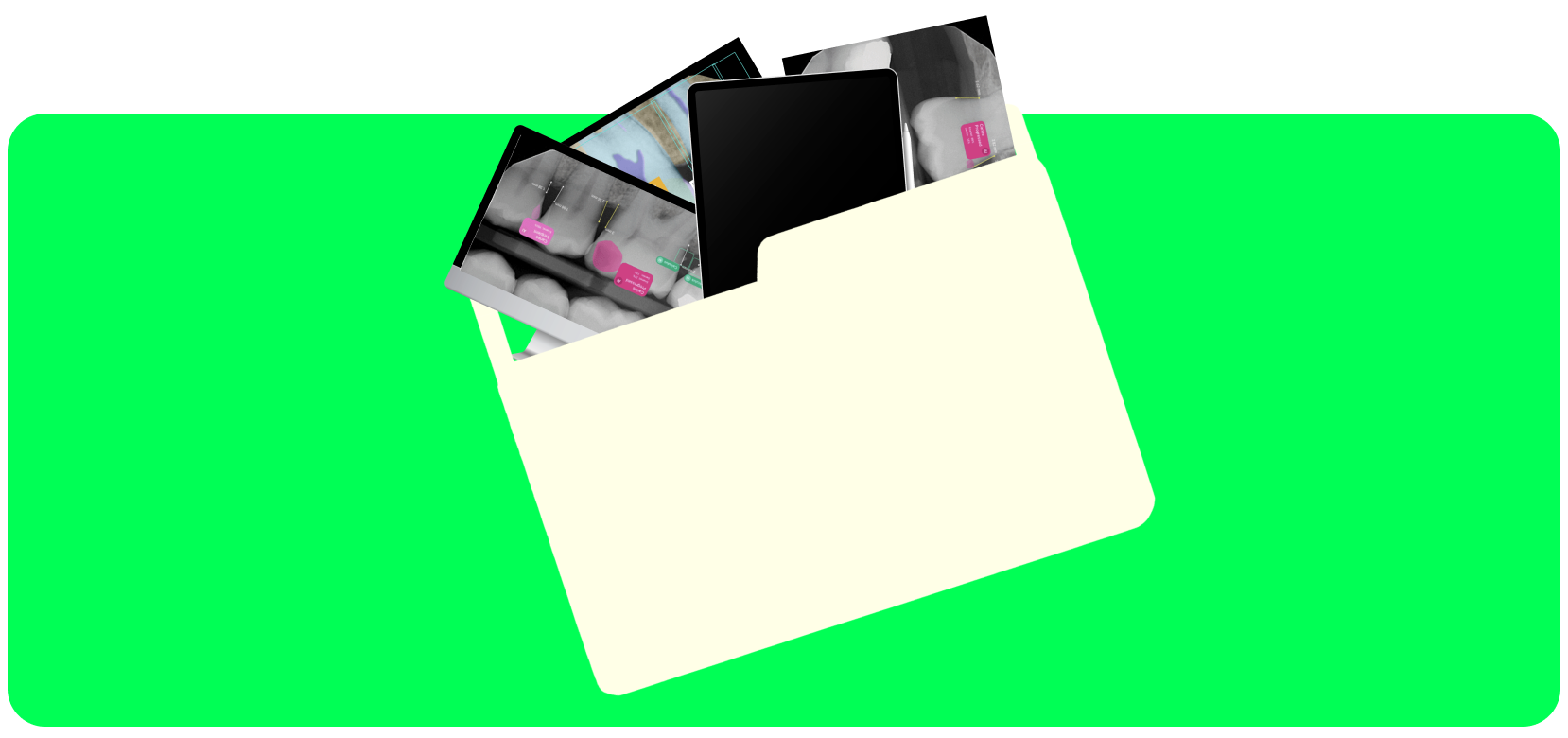
Whether you are an enthusiast or a sceptic, there’s no denying that AI is here to stay. A 2023 survey found that one in three dentists have already implemented AI in their practice, in some form, whether it be for diagnostics, imaging, or communication.
But with the rapid rise of AI, it can be difficult to know where to begin. That’s why we’re breaking down four AI tools that are making waves in dentistry, giving you a quick overview of what they do, who they are for, and how they perform in independent studies.
#1 Practice better with Pearl Dental AI
AI-assisted 2D radiograph analysis for everyday dentistry
How does it work?
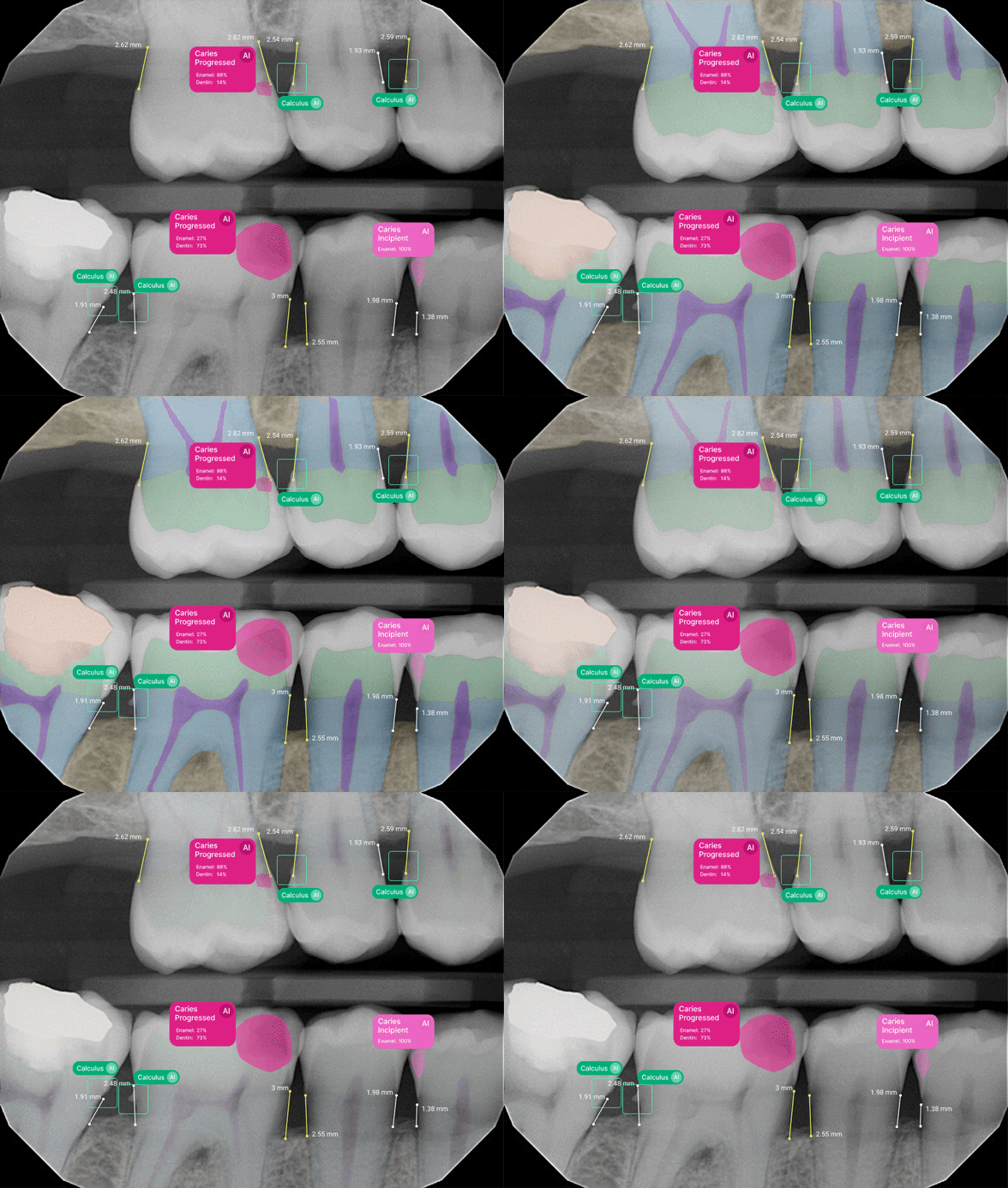
Pearl’s Second Opinion provides AI support to review radiographs. The system automatically highlights potential findings directly on 2D dental X-rays, such as caries, bone loss and periapical lesions. This helps clinicians spot issues more consistently, while the colourful overlay makes the X-ray easier for patients to understand.
Who is it for?
General dental practitioners and small clinics looking for an easy-to-use, explainable imaging tool that supports diagnostic accuracy and patient communication.
What are the limitations?
The AI cannot (and should not) replace clinical judgement. The accuracy depends on image quality and training data, which means it is often better at detecting common issues.
“Pearl is becoming something that I use every day to help me make my diagnoses. And it just really helps to bring to life what I'm explaining to patients as well as what's going on in their mouth.”
— Anna Middleton, Founder of The London Hygienist, Source: Pearl

Study assessing diagnostic accuracy
A recent study published in Diagnostics (2025) evaluated the performance of Pearl’s Second Opinion® AI (v1.1) in detecting common dental conditions on intraoral periapical radiographs.
Using 300 images representing over 1,000 teeth, researchers compared the AI’s accuracy to that of human clinicians. The AI demonstrated high sensitivity and specificity across multiple findings — including caries, periapical lesions, marginal bone loss, and crowns — performing particularly well in restorative and periodontal assessments.
The authors concluded that AI-assisted radiographic interpretation can enhance diagnostic consistency and efficiency in clinical settings. However, they noted limitations such as the single-clinic dataset, controlled image quality, and lack of 3D imaging data.
#2 Analyse dental images with Diagnocat
3D radiographic analysis and automated reporting
How does it work?
Diagnocat provides AI analyses of 2D and 3D dental images (CBCT, panoramic, and intraoral scans) to automatically generate detailed diagnostic reports. It can identify pathologies such as periapical lesions, caries or bone loss and create visual case summaries for patient communication or interdisciplinary referrals.
Who is it for?
Clinics and specialists who work extensively with 3D imaging and want to reduce reporting time while maintaining thoroughness.
What are the limitations?
The tool’s accuracy depends heavily on scan quality and segmentation. It has shown a tendency to give false positives, so the clinician should always evaluate any diagnosis.
Study assessing diagnostic accuracy
This 2025 study found that Diagnocat’s AI can detect periapical radiolucencies (PARLs) on CBCT scans with high sensitivity (93.9%) but moderate specificity (65.2%), meaning it catches most true cases but can overdiagnose healthy cases.
Accuracy dropped in scans of root-filled teeth due to imaging artefacts. Researchers concluded that while AI can boost detection and save time, clinical expertise remains essential to interpret results correctly.
#3 Get smarter with DentalMonitoring
Remote AI monitoring of orthodontic treatment
How does it work?
Throughout their treatment, orthodontic patients upload regular images using their smartphone and a dedicated device called The ScanBox. The AI tracks progress (fit of aligners, hygiene, movement) and alerts the clinician of any issues.
Who it’s for?
Orthodontic practices that want to reduce in-office visits, increase patient engagement, and monitor treatment between visits.
What are the limitations?
Relies on patient compliance, as they must take and upload images themselves. So if patients aren’t motivated, the data frequency drops.
Study of effectiveness in improving oral hygiene during orthodontic treatment
This 2023 study compared two groups of orthodontic patients to assess the motivational effects of DentalMonitoring (DM). One group used DM with weekly personalised notifications, while the other was a control group without the use of DM. After five months, the monitored group showed a statistically significantly lower mean Plaque Index (OPI ≈ 1.96) and Modified Gingival Index (MGI ≈ 1.56) compared with the control group (OPI ≈ 2.41; MGI ≈ 2.17).
However, hygiene levels in both groups declined during the study, and the authors noted multiple limitations, including sample size. They concluded that AI-based remote monitoring may enhance hygiene during orthodontic treatment and that further studies are needed on the topic.
#4 Never write dental notes again with Kiroku
Audio-driven clinical documentation for dental teams
How does it work?
Kiroku has existed since before the AI boom, but now uses AI and voice technology to convert spoken clinician notes into structured, editable dental records, including SOAP notes, referral letters, and treatment summaries. It integrates with popular dental practice management systems so team members can reduce typing and keep workflows smooth.
Who is it for?
Busy dental practices (especially multi-chair or hygienist-led clinics) that want to streamline documentation, improve consistency of notes, and reduce admin time while maintaining high standards.
What are the limitations?
As with all voice-to-text and AI-note tools, accuracy depends on clear speech, background noise and correct terminology. So it still requires a subsequent clinician review to ensure there are no errors.
As AI continues to evolve, its role in dentistry is expanding. Whether it’s sharper diagnostics, smarter monitoring, or smoother admin work, these tools can free up more time for what really matters: patient care.
“[From my patients] I often hear, ‘Does the computer decide instead of you?’ and I always reply, ‘No. AI supports me for your benefit. You still get my expertise plus an extra safety net.”
— Dr Devigus