
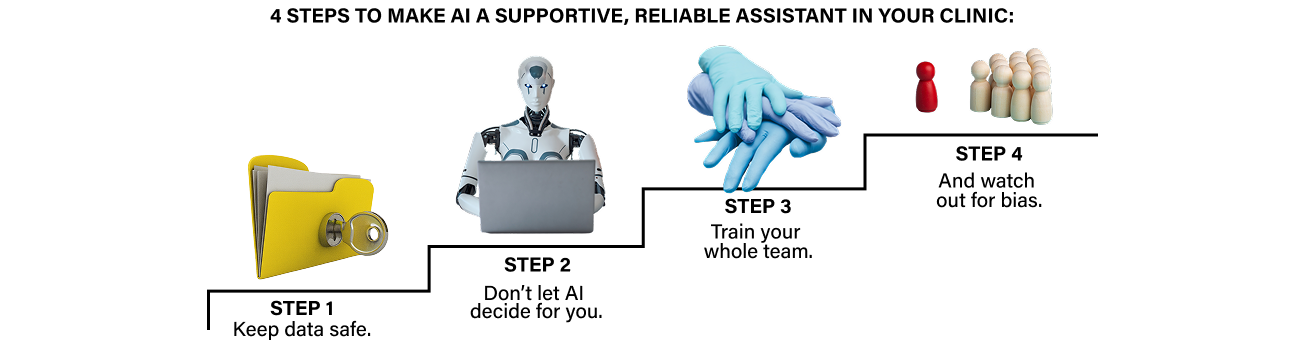
Mistake 1: Ignoring data safety
When you use an AI tool, it is your responsibility to ensure that patient data is handled correctly. Always check where your data is stored, who can access it, and whether the tool complies with data protection laws (GDPR, DSG, HIPAA, etc.).
This can be a daunting topic to address, and Dr Devigus recommends asking the following three questions to any AI vendor:
- Where is my data stored?
- Who can access it?
- Which regulatory approval do you have?

Mistake 2: Over-relying on AI outputs
AI can support your diagnosis, but it should never make decisions for you. AI is not infallible and can produce both false positives and false negatives. Forgetting this can be dangerous. So while AI can be highly useful, always remember to treat it as an assistant, not an authority.
“Think of it like your intraoral camera. It shows you what’s there, but you still decide what it means. AI is no different.”
– Alessandro Devigus
Mistake 3: Not taking time to train the whole team
Like any new tool, without proper training, AI can create confusion and mistrust. At the clinic, this affects both the team and the patients. To prevent this, Dr Devigus recommends making AI integration a team effort. By dedicating time to training, experimenting, and reviewing results together, everyone from the front desk to the surgery will feel confident and comfortable using the tool.
Mistake 4: Forgetting about bias
Remember how AI works from Module 1? It recognises a pattern and makes a prediction. Therefore, its ability to make accurate predictions is directly related to the data it was trained on. It is difficult to avoid bias altogether, but you can be aware of it. That is why Dr Devigus recommends asking vendors the following 3 questions:
- What data was your AI trained on?
- How diverse was it?
- Does it have peer-reviewed validation studies?
“As an oral health professional, it is important that you understand the limitations of the tools you use—and this goes for AI as well.”
— Alessandro Devigus
Up next: Exercise 1: AI workflow guide